
You Are Not Alone: A Message to Every Woman Struggling with Mental Health During Menopause
If you are reading this while feeling anxious, depressed, or desperate during your menopause journey, or what MIGHT be perimenopause, you’re not sure, please pause for a moment and know this: what you are feeling is real, valid, and treatable. Help exists, hope is possible, and above all else, you are not alone.
A Tragedy That Should Wake Us All Up
In February 2025, Donna Mann tragically took her own life after battling severe anxiety and paranoid thoughts. She was going through menopause. The inquest confirmed that Donna had experienced deteriorating mental health, made worse by her menopausal transition.
Donna’s story isn’t just a sad news article. It should be a wake-up call for society, healthcare providers, employers, and most importantly, for any woman currently struggling with mental health symptoms and wondering whether menopause could be playing a part.

I share this because I’ve been there too. I know the crushing weight of feeling like you’re losing your mind, of waking up already overwhelmed, anxiety and panic creating a sense of dread in your stomach, lacking energy and motivation, feeling like a burden. First wondering if anyone would understand and then feeling gaslit when your experience was denied or trivialised.
And I want you to know, this isn’t just happening to you.
Menopause Is More Than Hot Flushes
When we say “menopause,” most people still picture hot flushes or night sweats, but for many women, the most terrifying symptoms are mental, not physical.
- Anxiety that hits from nowhere
- Panic attacks that feel paralysing
- Low mood or depression that won’t shift
- Rage that feels completely alien and comes from nowhere
- Tears of frustration, sadness, overwhelming pain
- Disconnection, brain fog, and a loss of confidence
These aren’t character flaws. They aren’t personal failings. They are symptoms, symptoms of a hormonal storm affecting your brain chemistry, nervous system, and overall emotional stability.
The Hormone Connection
During perimenopause and menopause, levels of oestrogen and progesterone begin to fluctuate wildly. These hormones don’t just affect reproduction, they also regulate mood, support brain function, and influence serotonin and dopamine, the neurotransmitters responsible for feeling calm, stable, and motivated.
As oestrogen drops:
- Mood regulation suffers
- Sleep becomes disrupted
- Emotional resilience weakens
Progesterone’s calming effect also disappears, leaving women more vulnerable to anxiety, irritability, and insomnia. Double edged sword – the lack of oestrogen making us more susceptible and the lack of progesterone to recalibrate and calm our system.
Dr. Louise Newson, a renowned menopause specialist, has highlighted research that shows women in perimenopause and menopause are at far greater risk of poor mental health and difficult thoughts during this time, and European research suggesting we are up to seven times more likely to experience suicidal thoughts than at other life stages.
This is not a minor side effect. It is a crisis.
If This Is You Right Now
If you see yourself in any of this, please know:
- You are not being dramatic.
- You are not overreacting.
- You are not failing.
- You don’t need to pull yourself together, try harder or stop being such a wuss ..
You are navigating one of the most intense hormonal transitions of your life, and the mental health impacts are very real.
You might have been offered antidepressants without a proper assessment of your hormonal status. You might have been told to just “see how you go with this,” or dismissed altogether. That is not okay.
Your experience is valid. You deserve support.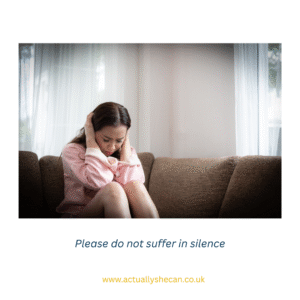
The Isolation Can Be Devastating
One of the hardest parts of menopause-related mental health struggles is how invisible it can feel. If your GP doesn’t get it, your partner can’t handle it, and even your friends don’t understand, it can feel impossibly lonely. Nobody else in your social circle has experienced this, you have nobody to talk to, nobody on your side.
You might think:
- “Other women seem to manage, why can’t I?”
- “Maybe I’m just weak.”
- “I’m losing my mind.”
- “If this is how life is going to be from now on …”
You’re not losing your mind, you’re not weak, life will NOT be like this forever.
You’re experiencing a hormonal transition that is often misdiagnosed and misunderstood and wrongly treated, especially when it comes to mental health.
We’ve been conditioned to downplay our struggles, to suffer in silence, to be strong as women, but that is costing lives.
There Is Help Available
The good news? We know more now than ever before.
- HRT (Hormone Replacement Therapy) can be life-changing, especially for mental health symptoms – for me it was a life-saver, for sure!
- Menopause-informed therapists can help you understand what’s happening and support you through it.
- Certain antidepressants, lifestyle changes, nervous system regulation tools, and dietary support can also play a role.
- There are other non-hormonal medications that can help.
- Therapy such as CBT has been shown to have fabulous results.
Most importantly: you are not expected to just put up with this.
What You Can Do
- Talk to your GP – Be specific about your symptoms and how they connect to menstrual or perimenopausal changes and do not be fobbed off. Go armed with information about your symptoms, frequency, intensity and any patterns.
- Ask about HRT – It’s not for everyone, but for many, it’s transformational.
- Seek a specialist – Menopause clinics or GPs with special interest in women’s health are often more clued up.
- Tell someone you trust – Partner, friend, colleague, HR. You need allies who will advocate for you and keep encouraging you when you don’t get an immediate result.
- Don’t wait for rock bottom – Early intervention makes a huge difference.
When the Darkness Feels Too Much
If you are feeling like you can’t go on, or if you’re having thoughts of self-harm or suicide, please do not keep that to yourself.
Reach out immediately:
- Samaritans (UK): 116 123 (free, 24/7)
- Text SHOUT to 85258
- Call NHS 111 or 999 if you’re in crisis
These thoughts are a symptom. They are not a sign of weakness, you are not being dramatic or overly sensitive – these are symptoms and they can be treated.
The Workplace Needs to Step Up Too
Menopause doesn’t stay at home. It walks into boardrooms, classrooms, hospitals, shops, and offices every day.
Mental health symptoms can:
- Undermine confidence
- Affect productivity
- Damage relationships at work
- Lead to absence, poor performance and capability issues.
Employers have a duty to create supportive environments. That can include: –
- Menopause policies
- Trained staff
- Obligation to consider reasonable adjustments
- Access to counselling or EAPs
- Flexibility and understanding
It’s not your fault. You are navigating something that requires awareness and support, not shame or dismissal.
A Final Word of Hope
The symptoms you are experiencing do not define you. They are not permanent. They are not a measure of your strength or your worth.
You can feel like yourself again. You can feel joy, clarity, peace. You can wake up without dread.
But first, you need to take one step. Just one. Book the appointment. Make the call. Tell someone.
Because support is available and there is always a solution – you might just need some help in finding it.
If this article has resonated with you, please share it. It might just save a life.